
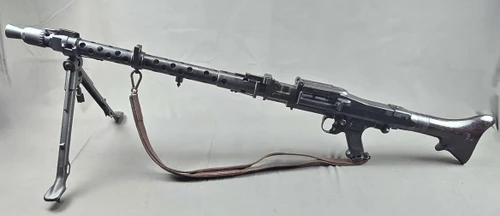


Replica Maschinengewehr 34 (MG34) Machine Gun. Built on original parts and a Philadelphia Ordnance display receiver.
The Philadelphia Ordnance MG-34 receiver has the following features:
- 100% machined exterior, all contours and surfaces fully machined
- Accepts original W.W.II MG-34 parts
- Barrel jacket fits on hinge pin, rotates, and locks like original
- Barrel can be removed/installed
- Feed tray snaps into place
- Cover assembly attaches using original spring loaded hinge pin
- Buttstock/buffer assembly attaches with interrupted thread like original, locks with original catch
- Cocking handle slides in track and interlocks with barrel jacket
- Trigger frame assembly attaches with original pins
- Safety fits, rotates, and locks trigger like original
- Ejection port cover fits and snaps open when trigger is pulled
The MG 34 (short for Maschinengewehr 34, "machine gun 34") is a German recoil-operated, air-cooled machine gun, first tested in 1929, introduced in 1934, and issued to units in 1936. It introduced an entirely new concept in automatic firepower – the Einheitsmaschinengewehr (universal machine gun) – and is generally considered the world's first general-purpose machine gun (GPMG). Both the MG 34 and MG 42 were erroneously nicknamed "Spandau" by Allied troops, a carryover from the World War I nickname for the MG 08, which was produced at the Spandau Arsenal.
The versatile MG 34 was chambered for the fully-powered 7.92×57mm Mauser rifle cartridge and was arguably the most advanced machine gun in the world at the time of its deployment. The MG 34 was envisaged and well-developed to provide portable light and medium machine gun infantry cover, anti-aircraft coverage, and even sniping ability. Its combination of exceptional mobility – being light enough to be carried by one man – and high rate of fire (of up to 900 rounds per minute) was unmatched. It entered service in great numbers from 1939. Nonetheless, the design proved to be rather complex for mass production and was supplemented by the cheaper and simpler MG 42, though both remained in service and production until the end of the war.