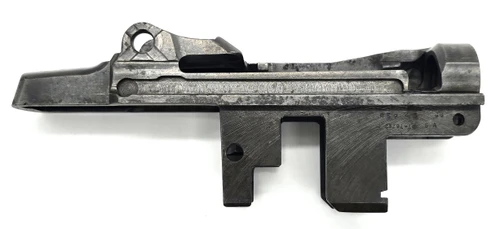

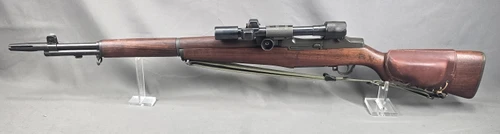


Springfield Armory M1D Sniper .30-06 cal Rifle Serial 5383284. This is an M1D rifle with no paperwork. All parts are original except, flash hider and scope mount. Barrel is dated S-A-2-52. See pictures for more information.
The M1 Garand or M1 rifle is a semi-automatic rifle that was the service rifle of the U.S. Army and United States Marine Corps during World War II and the Korean War. The rifle is chambered for the .30-06 Springfield cartridge and is named after its Canadian-American designer, John Garand. It was the first standard-issue autoloading rifle for the United States. By most accounts, the M1 rifle performed well. General George S. Patton called it "the greatest battle implement ever devised". The M1 replaced the (bolt-action) M1903 Springfield as the U.S. service rifle in 1936, and was itself replaced by the (selective-fire) M14 rifle on 26 March 1958.
Most variants of the Garand, save the sniper variants, never saw active duty. The sniper versions were modified to accept scope mounts, and two versions (the M1C, formerly M1E7, and the M1D, formerly M1E8) were produced, although not in significant quantities during World War II. The only difference between the two versions is the mounting system for the telescopic sight. In June 1944, the M1C was adopted as a standard sniper rifle by the U.S. Army to supplement the venerable M1903A4, but few saw combat; wartime production was 7,971 M1Cs.
The procedure required to install the M1C-type mounts through drilling/tapping the hardened receiver reduced accuracy by warping the receiver. Improved methods to avoid reduction of accuracy were inefficient in terms of tooling and time. This resulted in the development of the M1D, which utilized a simpler, single-ring Springfield Armory mount attached to the barrel rather than the receiver. The M1C was first widely used during the Korean War. Korean War production was 4,796 M1Cs and 21,380 M1Ds; although few M1Ds were completed in time to see combat.
A detachable M2 conical flash hider, adopted 25 January 1945 slipped over the muzzle and was secured in place by the bayonet lug. A T37 flash hider was developed later. Flash hiders were of limited utility during low-light conditions around dawn and dusk, but were often removed as potentially detrimental to accuracy.
As with all surplus firearms they should be checked by a professional gunsmith.
FFL REQUIRED AT TIME OF PURCHASE. ALL FIREARMS MUST SHIP TO FFL DEALER. NO EXCEPTIONS.
ALL PISTOLS NOT FOR SALE IN MASSACHUSETTS OR MARYLAND (PLEASE CHECK LOCAL LAWS)
PLEASE NOTE: FREE SHIPPING PROMOTIONS DO NOT APPLY TO FIREARMS ORDERS. SHIPPING CHARGES WILL BE APPLIED UPON SHIPPING.