

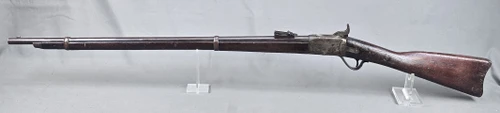


Providence Tool Company Peabody Breech Loading Antique Rifle. Caliber .45-70 gov. Rifle is marked CONN 1280. Cleaning rod is missing. Rifle is in good condition. This is an antique rifle and no FFL is required for purchase. See pictures for more information.
Pictures are actual firearm you will receive.
The Peabody action was an early form of breechloading firearm action, where the heavy breechblock tilted downwards across a bolt mounted in the rear of the breechblock, operated by a lever under the rifle. The Peabody action most often used an external hammer to fire the cartridge. The Peabody action was developed by Henry Oliver Peabody (13 May 1826 Boxford, Massachusetts – 28 June 1903 Hull, Massachusetts)[1] from Boston, Massachusetts, and was first patented on July 22, 1862. While the Peabody was not perfected in time for the American Civil War, a few were entered in the trials of 1864 with favorable reports.
Peabody carbines and rifles were made by the Providence Tool Company, Providence, Rhode Island; c. 1866–1871. The total production was 112,000 for all models. Calibers were: .45 Peabody rimfire; .45-70 Government; .50 rimfire; 50-70; 11 mm Spanish; 10.4 mm rimfire Swiss. Barrel length carbine 20", rifle 33". Finish: Receiver casehardened, barrel blued, iron mountings, walnut stock. The majority of Peabody's production was for foreign contracts. They were adopted by the militaries of Canada (3,000 pieces), Spain, Mexico, France (33,000), Romania, and Switzerland (15,000) during the later 1860s. In the United States, Massachusetts purchased 2,941 rifles, Connecticut in circa 1871–72 purchased 2,000 Spanish model rifles and South Carolina in circa 1877 purchased 350 carbines.
The Peabody rifle was one of a half dozen different rifles that took part in the 1866 Norwegian-Swedish rifle trials, where it lost out to the Remington rolling block (which became the Remington M1867 in Norwegian and Swedish service) because of its greater complexity, with more parts than the Remington design.
The Swiss gunsmith Friedrich von Martini created an action that somewhat resembled Peabody's, but incorporated a hammerless internal striker and used a toggle moved by the striker to lock the action during firing. Mated to a barrel with rifling designed by Alexander Henry, the Martini–Henry M1871 would become the British Army's standard rifle for twenty years.
The Liberian 600 Peabody rifles were bought in 1910, during the war with the Grebo tribe, from the German government via the Woermann Co. (de). They had been captured from the French army during the Franco-Prussian War and were sold along with tonnes of gunpowder, 200,000 rounds of ammunition, and 400 Mauser M1888 carbines. The cost was $20,000. In 1919, Liberians received Peabody rifles through US arms sales.