
(Pretty Much) Everything You Wanted to Know About the M9 Bayonet
Jan 27th 2026
The M9 bayonet, also known as the M9 Phrobis III, is a modern bayonet design, and was introduced in 1986 to replace the M7 bayonet, both of which were intended for the M16 rifle.
It remains a popular, yet divisive design, and despite its widespread use (and adoption by other militaries abroad) there are as many people that hate it as love it.
Here’s what you should know about the M9.
A Quick History of the M9 Phrobis III Bayonet
Early in the 1970s the United States made a decision to replace the M7 bayonet, mostly because changing battlefield tactics and accelerating technology resulted in lower and lower likelihood that there would be legitimate use for a bayonet in combat.
All the same, the military didn’t want to pivot entirely away from bayonets, just to make the design more versatile in the field. The ultimate result was the M9 bayonet, which was designed to do, perhaps, too much.
The new M9 was designed by Qual-A-Tec and based off of a Soviet model, the Russian AKM 6H3. The main difference was that we patterned our bayonet just a bit larger. Also, during testing, apparently the Qual-A-Tec prototype was the only one that passed every single test with a failure rate of 0%.
Knowing this, it’s important to recognize that there were several improvements (to use that word) that the M9 bayonet featured over the M7 it was intended to replace.
First, it was larger and heavier than the M7 bayonet it was destined to replace, which is odd, considering the impetus for the change was to shift away from reliance on bayonets; making one that was larger and heavier seems counterintuitive. It was also criticized for its size and weight on the ground that this added to a soldier’s overall loadout.
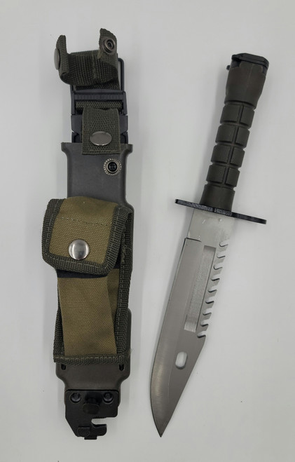
The M9 Phrobis sported a 7 inch clip point blade and was 12 inches overall, with a textured, non-slip grip of thermoplastic or molded nylon. The blade is larger and thicker than that of the M7, its predecessor, and the blade stock is considerably thicker.
This results in a heavier, thicker bayonet that could be used more brusquely, but it also yields two of the other complaints that have commonly been levied against the M9 bayonet over the years.
These are that the thicker blade stock was harder to sharpen, which made it more difficult to get a fine edge. This somewhat limited this bayonet’s design as a utility knife. The other is that the point, partially as a result of the thickness, was more oblique. This significantly limited the M9 as a thrusting weapon, which was potentially problematic as the main utility of a bayonet is for that express purpose.
The M9 was also manufactured with a two-piece rod tang. While lightweight compared to a full-tang, it was significantly weaker and, like all rod tangs, predisposed to failure. The blade actually threads onto the tang at the grip, which is a severe weak point. This also somewhat limited the design of the M9 as well as how aggressively it could be used.
The clip point blade was designed with serrations on the spine as well, which were intended to increase the overall versatility and utility of the tool so that the sawback could be used to cut cord, plastic, wood, and other tough materials. However, historically, bayonets with serrations were not well received by the international community, so the US toned down the serrations to the point that they are now almost functionally unusable, and just a cosmetic addition to the design of the Phrobis. Consequently, they are more of an aesthetic feature than a real bonus to the profile of the bayonet. (Although, some M9 models are made with fairly aggressive serrations that are more practical, as you can see from the image at the top of this article.)
The M9 bayonet was not just designed to serve as a rifle-mounted weapon. It was also intended to fill the role of a fighting knife and multi-tool. Specifically, it was designed with a hole in the blade that corresponds to a lug in the sheath with which it was issued.
This is one of the few features that actually conferred a purpose at which the M9 excels: as a wirecutter. The two can be fitted together and the device used to surprising effect to cut through metal. This bayonet pattern is also somewhat effective as a bottle opener and screwdriver.
Ultimately, the criticisms of the M9 bayonet revolve around the idea that the designers tried to cram too many features into one knife. What we ended up with was a bayonet that could theoretically do a lot of stuff. The thing is it doesn’t really do any of that stuff well. It’s just “good enough.”
Even so, don’t let this post make an unnecessarily severe impression on you regarding the M9. When in testing, the M9 was the only prototype that passed all of the military’s requirements, and considering its overall versatility, if any were added, it probably would have passed them too.
Here for an M9 Bayonet for Your Collection?
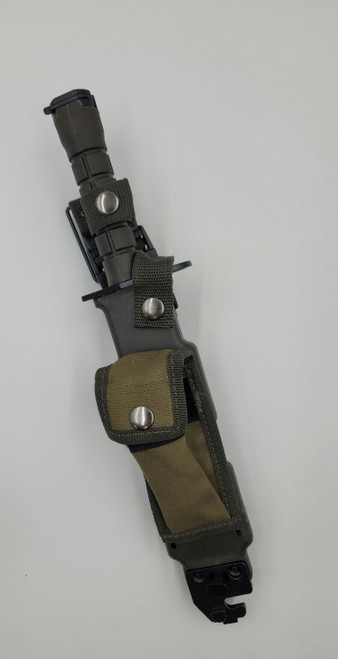
At the end of the day, even though the M9 bayonet has been met with criticism, it has still enjoyed a long service history and has seen plenty of use around the world, not just in the hands of American servicemen and women.
If you landed here because you want to add a bayonet to your collection, are looking for one that’s compatible with your M16, M4 or AR rifle, or just want a cool piece of military history, we have plenty of examples.
Get in touch with us directly if you have questions about model specifications or about the differences between the bayonets for sale in our collection. You can reach us at 610-250-3960 and we are happy to help.