
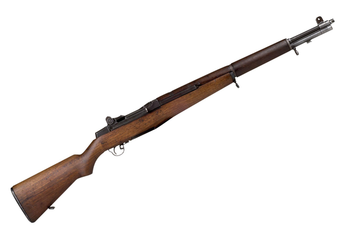
M1 Garand Facts
Feb 9th 2026
Suffice it to say the M1 Garand is not just the quintessential American rifle (yes, more than the AR-15) but that it is one of the most famous rifles of all time.
We rounded up some interesting facts and have compiled them here. See if you knew all of these.
1. The Garand’s cartridge is alive and well
Like the M1903 that preceded it, the M1 Garand is chambered in .30-06 Springfield, a cartridge that still sees an immense amount of sporting use in the United States, not just for competition, but in the hands of deer and big game hunters.
2. The M1 Garand utilized a gas-operated, closed-rotating bolt
The gas system of the M1 Garand rifle is a thing of beauty, and operates according to the following principle. When a cartridge is discharged, gas is diverted through a port into a gas cylinder, where it exerts pressure on a piston connected to an operating rod that is pushed rearward. This operating rod rotates the bolt inside the receiver, ejecting the spent cartridge before the recoil spring resets the action.
3. The Garand utilized an En Bloc clip
The en bloc clip of the Garand rifle is the source of a lot of confusion regarding the terms “magazine” and “clip.” The M1 Garand clip was designed to be inserted into the rifle’s fixed internal magazine, so that the action stripped rounds off the clip, from the magazine, and into the chamber.
4. Without the clip, the Garand can only be loaded with single rounds
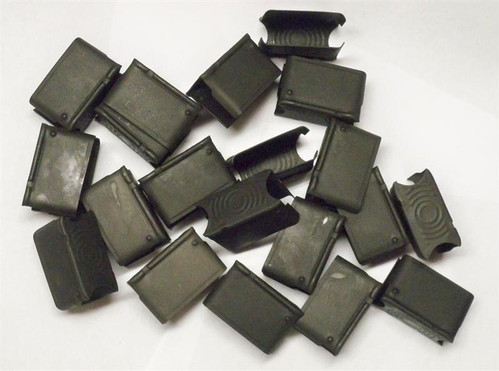
Many rifles with an internal magazine can be loaded with individual rounds to fill the mag. Without an en bloc clip this is not possible with a Garand and the rifle can only be loaded with, and fire, single rounds.
5. You should always keep your fingers out of the action of a Garand when releasing the bolt
There is a famous condition known as “Garand” thumb or “M1 thumb” that occurs when a careless user releases the bolt while his fingers are in the open action of the rifle, causing the bolt to slam forward, trapping the fingers against the breech. The condition is quite painful and can easily cause a bruise.
6. The Garand saw limited service in Vietnam
While the Garand is most closely associated with the Second World War, it saw service through the Korean War and even some limited service in Vietnam.
7. The Garand hasn’t just been used by American troops
More than 20 countries in addition to the United States have adopted the M1 Garand into official service, and in fact, several countries still use the rifle ceremonially, including Belgium, Greece, the Philippines, Norway, and several others.
8. Later variants were chambered in 7.62x51mm NATO
While the essential Garand was chambered in .30-06 Springfield, later variants, such as the T36 and T47, were chambered in 7.62x51mm NATO cartridge.
9. The M1 Garand and M1 Carbine are not related
The M1 Garand and M1 Carbine follow a naming convention that follows other production, such as the M1 Helmet and M1 bayonet, and the rifles are not related to each other, despite the fact that they were produced in the same era and saw combat side by side in World War II. They are completely distinct platforms that don’t even share the same cartridge.
10. Experienced soldiers could fire nearly a round per second
It has been reported that experienced marksmen could fire up to 50 aimed shots per minute, which is nearly a round per second, even more impressive considering the fact that the Garand’s en bloc clip only held 8 rounds. It would necessitate numerous reloads to accomplish such a feat.
11. The “ping” rumors are probably nonsense
There is a pervasive myth that enemy soldiers would wait for the notorious ‘ping’ of a Garand ejecting its clip, signifying that the soldier was out of ammo, before leaving cover to offer return fire.
However, even a little scrutiny all but debunks this claim. For one, the ping of the Garand would hardly be noticeable over the din of war, especially in active engagement. On top of that, there’d be little reason for an enemy to think that an American would not be covered by allies, even if he were out of ammo.
12. More than 5 million were made
Estimates and official figures suggest that 5.4 million M1 Garand rifles were produced, and sporterized versions are still encountered on the secondhand and surplus markets at military surplus rifles.
13. The British rejected the M1 Garand as a replacement for the Lee-Enfield
The Garand was proposed as a replacement for the Lee-Enfield rifle of the British Commonwealth forces, but it was rejected on the presumption that the semi-automatic, autoloading action of the Garand would prove unreliable in muddy conditions.
14. The Garand first saw service in the Philippines against the Imperial Japanese
When the Japanese first encountered American troops in the Philippines at the end of 1941 and into early 1942, they were shocked that the Americans could afford to outfit every troop with a machine gun. Of course, they were mistaken, and the rapid fire of troops equipped with Garand rifles was only semi-automatic and not fully automatic. Still, the rate of fire and power of the Garand were unexpected by the Japanese, who were outfitted with bolt-action Arisaka rifles that could hardly match the speed and power of its American counterpart.
15. At the beginning of the war, some troops were still equipped with M1903 rifles
Wartime constraints required that some troops were not issued M1 Garand rifles and instead saw service with bolt-action M1903 rifles.
Here for M1 Garand Parts?
SARCO, Inc. carries one of the widest collections of M1 Garand parts and accessories, including en bloc clips, in the industry. Whether you need new springs or a Garand stock, check out our collection first to find what you need.
If you can’t find what you’re looking for or don’t know what part you need, get in touch with us and we’ll help you find it.