
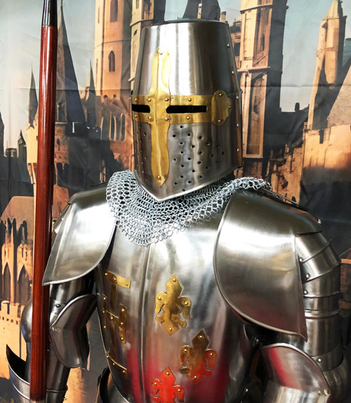
Interesting Facts About Suits of Armor
Aug 4th 2026
Among the more interesting curiosities that we sell here at SARCO, Inc. are full-sized suits of armor, inspired by a wide range of historical pieces of armor, at surprisingly competitive prices.
Great for displays, as educational pieces, or just as a nice addition to a bar or man cave, these suits of armor will rarely fail as conversation starters, and on that note, here are a few of the more interesting facts about them that you might want to dredge up if you’re ever approached.
- Armor was heavy, but not nearly as much as you think it was.
There have been historical representations in the media about cranes being used to lift knights wearing plate armor into the saddle. If the suit of armor weighed so much that heavy equipment was needed to “load” a knight onto his destrier (war horse), then how could that knight have been expected to fight under his own power? The representation is ridiculous.
Yes, a full suit of armor is heavy, but generally, the full suit would weigh only between 45 and 55 pounds, and perhaps a bit heavier on the extreme end. But even so, that weight was distributed across the knight’s entire body, making it easier for him to shoulder the burden.
- Suits of armor were extremely expensive and difficult to maintain. (Fortunately not the case for modern replicas.)
There is a reason only the nobles could afford to don full suits of armor. Not only did it take a long time and a lot of skill to forge (and potentially temper) plate armor, but on top of that, early armor was made from iron, not steel, and iron rusts a lot more readily than steel. That means that mud, salt, water; all of these things could and would cause corrosion. That meant that a knight, his squire, or other attendants would need to meticulously clean and safeguard the armor so it wouldn’t rust away.
- Not all armor was made of iron.
Suits of plate armor in Europe during the Middle Ages were conventionally forged from armor, but earlier examples may have been made from cloth, wood, or even formed leather. Some Roman armor, which predated European iron plate armor, was made from formed leather which offered a surprisingly good level of protection. Not as good as iron, but not bad.
- Suits of armor were highly articulated.
Just like the myth that suits of armor were so heavy that knights couldn’t move, there is another myth that the suits of armor severely limited mobility. While it is potentially true that a combatant not wearing armor would be more mobile and agile than one who was, it is also the case that the armorers who made armor did a shockingly good job of articulating the armor they produced. You would be surprised to see how much mobility a knight could exercise. If you ever get a chance, look up a video. It’s amazing how flexible the armor was at the joints.
- Plate armor had a significant advantage over mail.
While mail was very flexible and could be effective at turning a blade, it was not particularly effective at redirecting forces, which meant that melee weapons like axes, maces, and flails were still devastatingly effective against it. Plate armor was much more effective in combat against these weapons.
- Gunpowder began the decline of plate armor during the Medieval period.
While plate armor was largely effective against most melee weapons and even against most arrows fired from a longbow, the proliferation of firearms using gunpowder helped bring about the decline of plate armor.
- Some helmets had flanges that helped prevent thrusts directed at the eyes.
Some helmets had flanges near the eyes that would cause the point of a blade to “skip” over them, missing the knight’s eyes, and increasing the level of protection afforded by the armor.
- Some crossbows fired bolts that could penetrate plate armor.
Some crossbows were made with iron limbs that could store much more energy than wood, as well as fine field points that concentrated an immense amount of power, capable of punching through plate armor.
- A Medieval helmet inspired the Stahlhelm, a WW2 German Helmet (technically from WW1).
A Medieval helmet design, the sallet, which protected the nape of the neck and afforded deep coverage, served as the inspiration for the Stahlhelm, a German helmet design that was developed on the Western Front in 1916 in response to the high number of fatal head wounds that Imperial German Soldiers were experiencing.
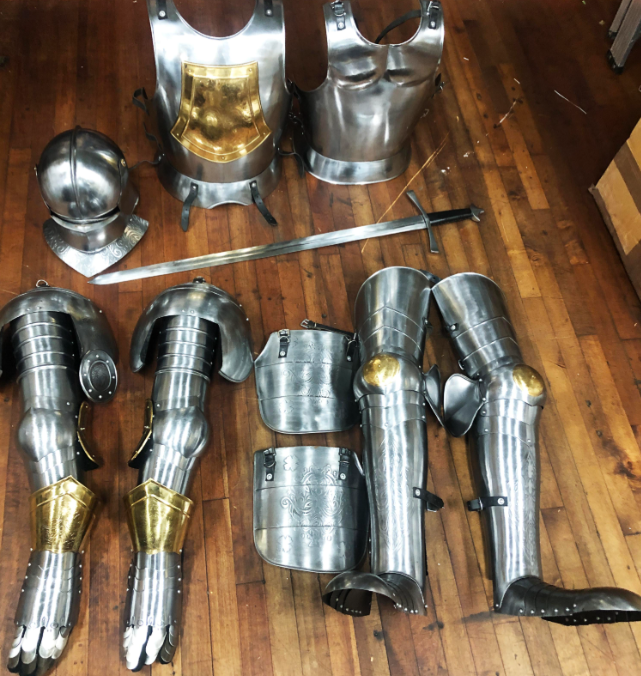
Invest in a Life-Sized Suit of Armor for Your Collection
Explore the life-sized suits of armor that we sell here and if you have any questions about them or how to maintain them, get in touch with us and we will be more than happy to help.