
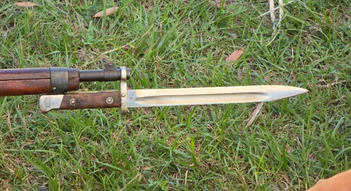
Interesting Facts about Bayonets
Apr 29th 2026
Among the many military collectibles and reproductions we sell here are bayonets, including replicas of historically significant models, like Enfield spike bayonets, original M1 bayonets, and even modern versions like the M9 bayonet.
We’ve compiled some interesting facts about these unique military weapons that, even today, are used, hundreds of years after their inception. See if you knew the following 7 facts about them.
- We don’t know exactly who created the first bayonets, but they were quickly adopted.
It’s not just us; no one knows who first invented the bayonet for sure, but it’s believed that bayonets originated in Bayonne, France, sometime in the 1600s, and were adopted quickly thereafter by European militaries. Considering the name, the origin story is somewhat likely.
- The first bayonets were plug bayonets.
Socket bayonets and bayonet lugs are things of modern invention. The first bayonets were little more than knives that literally fit into the muzzle of the guns with which they were paired. They were called plug bayonets for this reason.
Sound like a faulted design? Well, it definitely had its shortcomings. Because of the nature in which the bayonet was “fixed” (it wasn’t, it was just pushed into the muzzle) it could not be placed into position until after the firearm was discharged. It also meant that a loaded firearm was useless while the bayonet was in the muzzle.
Of course, this deficiency gave rise to more advanced iterations that affixed via sockets, lugs or barrel rings, and which were offset so that the rifle and bayonet could be used in tandem.
However, at the time, plug bayonets did what they were intended to do well enough, since they were only used with single-shot muzzleloading arms.
- Bayonet design was overhauled during WW1.
At the outbreak of WW1, sword-style bayonets like the German Seitengewehr 98 and the American M1905 were prevalent. These bayonets gave the user greater reach and enabled more powerful thrusting and slashing attacks. The idea was that the opponent with the longer reach would have the advantage.
However, things quickly devolved during the course of World War I, especially along the Western Front where the war became a protracted engagement of attrition, mired in trenches that hardly moved a few feet forwards or backwards at a time.
It wasn’t long before militaries became aware of this, and the extra reach of a sword bayonet actually served as a disadvantage in the cramped confines of the trenches. Partially as a result of this, the length of bayonets started trending downwards.
- Many modern rifles are still compatible with bayonets.
There are many modern rifles still in production that are compatible with bayonets. For instance, the US M16 is equipped with a bayonet lug that is compatible with the M7 and M9 bayonet. Other rifle platforms such as the CZ Bren 2, Steyr AUG, and HK 416 are all compatible with bayonets of their own.
- A major bayonet charge in a military engagement occurred as recently as 1951.
On February 7th, 1951, American soldiers of the 27th Infantry (known as the Wolfhounds) under the command of Captain Lewis Millett found themselves trapped around the base of Hill 180, under Chinese and North Korean fire.
Captain Millett had read a translated enemy report that claimed that Americans were unwilling to engage in close-quarters combat. Thinking to take the enemy aback, he fixed his bayonet and ordered his men to charge after him up the hill.
The fighting was intense, but despite the opposition, only 9 American lives were lost, to nearly 100 enemy soldiers. The Americans gained the position.
That remains the last-well documented American bayonet charge. For his actions, Lewis was awarded the Medal of Honor on July 5th, 1951.
- The M1 Carbine was originally issued without a bayonet lug.
The M1 Carbine is nearly as infamous for the role it played in WWII (and beyond) as the M1 Garand is, but did you know it was originally designed without a bayonet lug? As a result, it was issued with the M3 fighting knife. Only later iterations of the M1 Carbine were issued with a bayonet lug, compatible with the M4 bayonet.
- Modern bayonets are not designed solely as weapons.
Early bayonets were designed effectively just as thrusting and slashing weapons, to supplement the abilities of a rifle. Modern bayonets, like the M9 bayonet, can fill several roles as a utility tool, such as a wire cutter and a can opener, in addition to serving as a sidearm.
Explore Bayonets, Swords, Knives and Other Military Collectibles Here
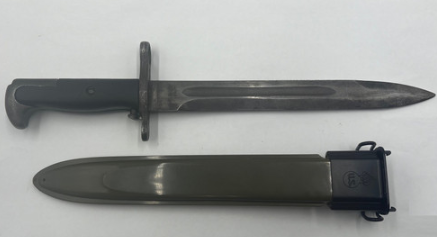
We carry a wide range of original bayonets as well as replicas, knives, swords, and other tools and field gear. Take a look through our collection and if you have any questions or are looking for something specific that you don’t see listed, get in touch with us directly and we will help you out.