
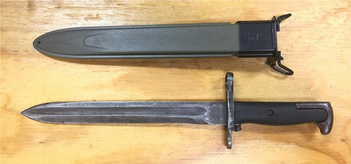
Famous Bayonets for Sale
Jan 13th 2026
For nearly as long as humans have used firearms, they have used bayonets in some form or other. This should come as no surprise, considering that polearms predate firearms, and that the first firearms were cumbersome, single-shot muzzleloaders, which needed effective supplementation on the battlefield anyway.
That being the case, bayonets have come a long way since the first plug-style bayonets that were inserted directly into the muzzles of the guns with which they were paired. And, as arms have advanced, the bayonet has evolved, rather than going obsolete.
This short post will go over some of the bayonets for sale here at SARCO, along with some other historically significant patterns.
Pattern 1907 Bayonet
The Pattern 1907 bayonet, also referred to as the “Sword Bayonet, Pattern, 1907, Mark 1,” was a British sword-pattern bayonet designed for the Short Magazine Lee-Enfield rifle (SMLE), which was widely used by Commonwealth forces throughout the First and Second World Wars.
Almost 22” overall, this sword-pattern bayonet offered excellent reach, but this very attribute was a potential drawback in the close-quarters engagements and trenches of WW1. Early models featured a hooked lower crossguard that could be used for grappling or for trapping an enemy’s bayonet during a struggle.
M1917 Bayonet (P17 Bayonet)
The M1917 bayonet, also known as the P17 bayonet, was a US design that was made for the Enfield rifle, with which many American troops on the Western Front were issued in the First World War. While the US official issue was the M1903, production and supply chain issues required that many American soldiers be outfitted with what their European allies could supply, and therefore many AEF soldiers were equipped with Enfield rifles.
With a 17 inch blade and over 22 inches overall, this, like other bayonets of the era, was a sword-pattern bayonet. In addition to compatibility with the US Enfield, the M1917 bayonet was also designed for compatibility with several models of trench shotguns.
M1905 Bayonet
The M1905 bayonet was an American bayonet designed for the M1903 Springfield. It featured either plastic or wooden grips, and like the British 1907, was a sword-style bayonet with a long blade, in this case, 16”. This bayonet is also compatible with the M1 Garand but was later modified (see below) for superior handling and serviceability.
Like other sword-style bayonets, the M1905 offered wielders greater reach, which could be both a blessing and a curse, given the battlefield conditions.
M1 Bayonet
The M1 bayonet was an interaction of the M1905 which was effectively exactly the same, except for the fact that it had a shorter blade. In fact, some M1 bayonets were just M1905 bayonets with their blades ground down to 10 inches to improve handling, especially in cramped quarters.
The M1 bayonet was expressly designed for compatibility with the M1 Garand rifle, and was issued to American troops who served in World War II, where it performed well when matched up against troops with bayonets of similar lengths.
M4 Bayonet
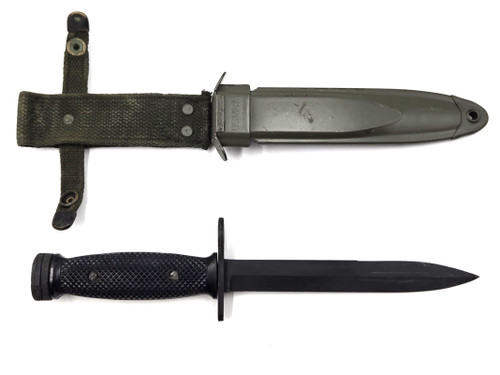
The M4 bayonet was patterned after the M3 fighting knife that was issued to troops along with the M1 Carbine, since the original M1 Carbine lacked a bayonet lug. This is a relatively short, compact bayonet compared to the others listed so far, and had a blade length of only 6.75”; the whole bayonet was less than 12” overall.
Because of its small, compact design, when removed from the M1 Carbine, the M4 bayonet was also serviceable as a fighting or utility knife, and handled well for general purpose field applications.
M5 Bayonet
The M5 bayonet was another bayonet that was adopted by the United States military for compatibility with the M1 Garand rifle. This one was adopted in 1953 in response to field observations that working with the M1 bayonet with heavy gloves on was difficult.
In the cold conditions of the Korean War, soldiers equipped with heavy gloves struggled to affix and remove their M1 bayonets; the M5 had a stud on the crossguard that engaged the gas cylinder lock screw of the Garand rifle, and which was easier to handle with gloves.
The design is notable because it entirely lacks a barrel ring, making it look more like a fighting knife than a bayonet.
M9 Bayonet
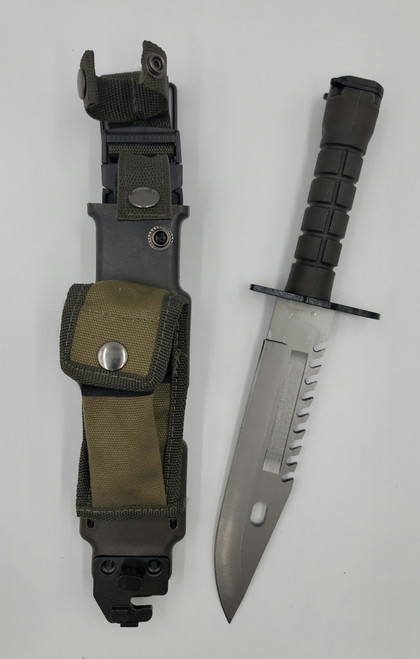
The M9 bayonet is a relatively modern bayonet that was adopted by the United States in 1986 for compatibility with the M16. The design of the M9 bayonet represents a substantial departure from earlier bayonet models, given the increasing scarcity of engagements in which bayonets could be used. Rather, the M9 was designed to serve as a field tool that was also practical as a bayonet.
The M9 bayonet sports a 7 inch clip point blade and is 12 inches overall, making it large enough to be detached and serve as a standalone fighting knife, but not overly sized so as to be cumbersome in the hand.
The M9 bayonet is noteworthy in that it has a hole in the blade that corresponds to a lug on the sheath; the blade can be attached to the sheath so that the knife can be used as a wire cutter. It was also designed to offer maximum utility as a multi-purpose tool and was intended to be practical as a bottle opener and a screwdriver.
Seitengewehr 98
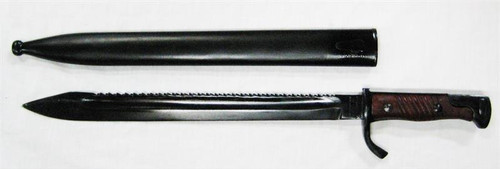
The Seitengewehr 98 was a German bayonet pattern, designed in response to an earlier French design, and which was developed for compatibility with the Gewehr 98 rifle that was issued to Imperial German Troops in the First World War.
With an imposing blade nearly 21 inches long, this bayonet became famous as the “butcher blade,” a moniker that was used to malign German troops in the First World War, despite the fact that sword-style bayonets were widely used on both sides of the conflict.
Explore These and Other Bayonets for Sale Here
Interested in seeing other examples of bayonets for sale, both originals and replicas? Take a closer look through our collection and let us know if you’re looking for a model you don’t see listed. We’ll try to help you find whatever it is you’re looking for.