
Explaining the Different Types of Rifle Slings
Feb 18th 2026
Whether you’re looking for a rifle sling to make it easier to carry your favorite rifle in the field or in competition, need one that will improve weapon retention should you need to draw a sidearm, or simply want something to make your M1 Garand appear more historically compelling, there are rifle slings for every purpose.
This short post will break down the three major classes of rifle slings, what they are used for, and why, how and where slings offer value in the first place.
1-Point Slings
A one-point sling is a special kind of rifle sling that only contacts the rifle at one point, hence the name. Unlike a two-point sling, the purpose of a one-point sling is to improve weapon retention should you need to drop your rifle and draw a sidearm in a second.
It is also the case that since a one-point sling only contacts the rifle at one point, you can easily switch the shoulder on which you’re carrying the weight of the rifle, almost instantly. This offers a considerable advantage when engaging a target in cramped quarters.
Many one-point slings are compatible with MOLLE mounts, making it possible to attach your sling to a vest, plate carrier or pack rather than just wearing it looped over your shoulders.
All in all, the main value delivered here is that, should you drop your rifle because it has jammed or run empty and you need to draw a sidearm, you won’t lose your rifle. The other advantage is that, in the event you ever engage or grapple with a hostile target hand-to-hand, it will be more difficult for that hostile target to remove the rifle from you by force.
With that being said, there are some considerable disadvantages associated with the use of a one-point sling, as well. One of the biggest of these is that, when you drop your rifle, it won’t always fall in a pleasant or comfortable position. This is invariably better than losing the rifle but still inconvenient, to say the least.
The nature of one-point slings is such that, in order to keep your rifle balanced and not swinging around, you will want one hand on it to stabilize it. This means it’s very difficult to carry a rifle with a one-point sling in an entirely hands-free manner.
Lastly, the way more one-point slings are designed makes it effectively impossible for you to carry the rifle on your back, so be aware of that.
2-Point Slings
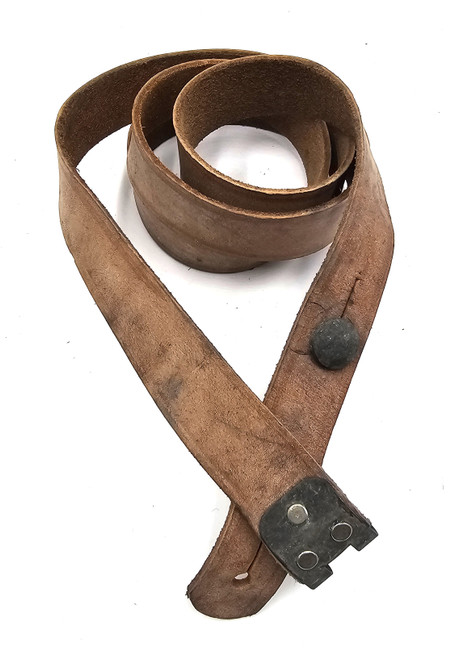
A two-point sling engages the rifle at two points, hence the name. Most commonly a two-point rifle sling will attach to mounts on the forend or handguard of the rifle as well as to the stock.
As a result, two-point slings naturally balance better than one-point slings, which enables you to slide the rifle around to your back. With a two-point sling, you can shoulder your rifle and carry it completely hands-free, and quite comfortably.
All in all, a basic two-point rifle sling is likely the style of sling most people think of when they hear the word “gun sling.” They are very commonly used, especially by hunters and other competitors who need to carry their guns hands-free for prolonged periods of time, or for relatively great distances.
One potential disadvantage of two-point slings is that you can’t remove the rifle from the shouldered position to the ready position easily, at least not in most cases. A two-point sling is optimized for carrying the rifle or shotgun first, and for readying it secondarily.
In most cases, you need to remove the rifle or shotgun from your shoulder so it can be readied. Also, switching shoulders can be difficult if the sling is not long enough. However, with a sling of adequate length, or at least one that is adjustable, it’s a bit easier.
All of this being said, one-point slings tend to be better for weapon retention or for getting a rifle from slung and into a ready position, whereas two-point slings are superior when it comes to shifting the weight to your back so the gun can be carried completely hands-free.
3-Point Slings
We also have three-point slings, which are somewhat less common than one and two-point slings, but which should be mentioned for the value they offer nonetheless.
Three-point slings, like two-point slings, attach to the rifle at two points, but they also have a loop for your body which sort of becomes the “third” point.
They offer very secure carry options and even an option to carry on your back in the “climber’s carry” configuration, which is useful when you need a very stable option for transporting the rifle, or, as stated, when climbing.
In terms of security and comfort, they are likely among the best of all rifle slings. However, it is very difficult to transition a rifle from “slung” to ready with a three-point sling, making them somewhat impractical in scenarios in which you would need to ready the rifle at a moment’s notice.
Partially as a result of this reason, three-point slings are not very common, especially compared to one and two-point rifle slings.
Why Use a Rifle Sling?
Whether you ultimately settle on a one or two-point sling, or even a three-point sling, here are some advantages of outfitting your gun with a sling:
- They can improve weapon retention.
- They can transfer some of the weight from your hands to your shoulders or back.
- They can make it easier for you to transport the rifle more comfortably over land.
- Some of them enable you to carry the rifle or shotgun entirely hands-free.
- Some slings, such as M1907 slings, can be used sort of like a brace to stabilize your arms so you can shoot more accurately offhand.
Though this list is not complete, these are some of the best reasons to outfit your gun with a sling.
Explore Rifle Slings and Other Accessories Here
In the market for a new sling? Check out what we have in stock here, and get in touch with us if you have any questions or need a recommendation.