
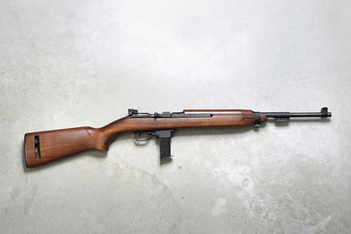
About M1 Carbine Variants
Mar 16th 2026
Even before the outbreak of World War II, it was determined that the M1 Garand rifle was too heavy for some soldiers to practically carry, especially those in support roles. It could weigh more than 10 pounds and account for a considerable portion of a soldier’s kit.
The Army wanted a lighter rifle with a correspondingly lighter chambering to fill a support role, especially one that was light and nimble enough to respond to the German’s blitzkrieg tactics. It had to be more powerful than a handgun but lighter than the Thompson gun, both of which were chambered in .45 ACP anyway.
The result was the M1 Carbine, chambered in .30 Carbine, considerably more powerful than most handgun cartridges, but still lighter than the .30-06 paired with the M1 Garand.
As is the case with most weapons platforms developed and manufactured during the Second World War, more than one variant of the M1 Carbine was developed. This post will cover some of the main variants.
M1 Carbine
The M1 Carbine is a roughly 5 to 6 pound rifle, loaded and slung, chambered in .30 Carbine, which only delivers about a third the power of the Garand’s -.06, but twice as powerful as the .45 ACP that was carried by troops for the M1911 and Thompson SMG.
The operation of the M1 Carbine was predicated on a gas-operated, short-stroke piston with a rotating bolt. At 35.6 inches overall and with a 17.75 inch barrel, this platform was considerably smaller and lighter than the M1 Garand, and therefore well-situated to serve in support roles in the hands of medics and radiomen.
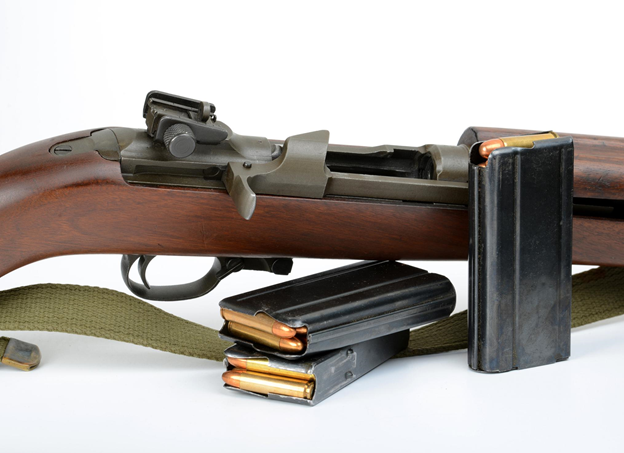
The first M1 Carbine had adjustable, flip-up rear sights and a fixed post front sight protected by wings. Unlike the Garand, which was chained to its En Bloc clip and a fixed internal magazine, the Carbine fed from a detachable box round, either 15 or 30 rounds (also known as a banana mag).
The M1 Carbine was also originally issued without a bayonet lug, unlike the M1 Garand, which was compatible with the M1905 and M1 bayonet (some of which were just ground-down M1905’s anyway). To address this deficiency, the first M1 Carbine rifles were issued with M3 fighting knives in lieu of a bayonet.
Later in the war, M1 Carbines were issued with flash hiders to reduce the muzzle flash and keep the sight picture clear. These were not issued, however, until the advent of the M3 variant of the carbine.
One interesting fact about the M1 Carbine is that, during testing, operators commonly mistook the magazine release for the safety release, causing operators to drop the mag unintentionally. This caused a redesign of the safety button; it was later issued with a rotating safety selector lever rather than a button, which was intended to help rectify the above-mentioned situation.
M1A1
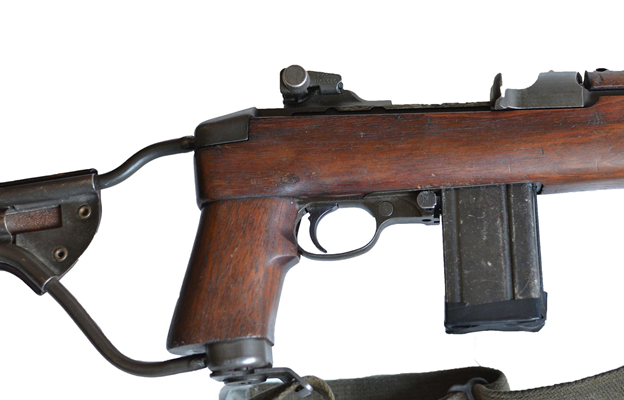
The M1A1 is a variant of the M1 Carbine that is the same in most respects except that it was issued with a side-folding stock. The design of the folding stock, which had a wire frame, is that the stock could not be locked open and was only held in the open position under the influence of a spring connected to the lower hinge assembly.
This side-folding design was developed in order to meet the needs of paratroopers that needed not just a lighter, but more compact variant. In addition to being issued to airborne troops it was also issued to some light infantry.
M2
The original M1 Carbine was semi-automatic only, but by 1944, a selective-fire variant known as the M2 Carbine was issued, which was capable of fully-automatic fire. With the M2 came the issue of the 30-round “banana” mag.
In addition to the M2 Carbines produced, some original M1 Carbines were converted to selective-fire versions, effectively transforming them into M2 variants using a special kit that included a modified sear and slide as well as a different trigger housing and a disconnector, lever, and selector.
M3
One of the most interesting of the M1 variants is the M3 Carbine which was designed without iron sights and which was instead equipped with an infrared night sight. It was first used in the invasion of Okinawa in which it was used to great effect, enabling Americans to detect Japanese making hostile offensive maneuvers against their positions at night, even under complete darkness.
By Korea, the design of the M3 Carbine was improved; though it still required the operator to carry a heavy battery pack, it could not just be used to dispatch individual hostile targets, but when paired with tracer rounds, could give a visual signal to machine gunner crews as to where the largest concentration of enemy positions was.
Shop M1 Carbine Parts Here
Hopefully you found this guide to different M1 Carbine variants helpful; if you’re here M1 Carbine parts, take a look through our collection and get in touch with us if you have questions about compatibility.