

9 Things You’ll Be Glad You Read About Cleaning a Gun
Jan 12th 2026
There are thousands and thousands of firearm platforms out there, and not all of them are even breech loaders.
In addition to muzzleloaders, we have all different sorts of actions, not to mention that some are autoloaders, which complicates things. Some have magazines and some don’t.
Therefore, no guide on how to clean a gun could be truly complete, unless it was specific to one given platform.
That being the case, there are some things you should know about cleaning a gun that are nearly universal. Here are 9 of them.
Break out the gun cleaning kit and get to work, after you read this.
Safety Is Paramount
First, nothing you will read here is more important than safety. Open the action, then drop the mag and inspect the chamber and magazine. Now double check. Make sure both are clear and that there is no live ammunition anywhere in the vicinity before you attempt to clean.
Never Clean from Muzzle to Chamber
If your firearm is rifled, regardless of whether it’s a handgun, a rifle, or even a slug gun, do not clean it from muzzle to chamber, unless you have a cleaning rod guide.
The reason this is so critical is because incidental contact with the cleaning rod or jag at the muzzle crowning can deform it. Since the crowning is the last rifled portion of the barrel with which a projectile is in contact, if the crowning gets deformed, it will severely and adversely impact accuracy.
Just follow this rule: clean from chamber to muzzle, every time.
Powder Fouling Solvent Will Not Necessarily Remove Copper and Lead Fouling
Next, when you take a bore light to the bore, you’ll see all those black specks and streaks. That is, by and large, powder fouling. Pretty much any bore solvent (or just warm water) will get rid of it.
However, some solvents only remove powder fouling and not copper or lead fouling, which, when they are allowed to accumulate in the barrel, can adversely affect accuracy, especially after a few hundred rounds.
For a quick cleaning with your gun cleaning kit, after a day in the field or a trip to the range, getting rid of the powder fouling is all you need to worry about. But when you break down the gun for a deep cleaning, it behooves you to get copper or lead fouling solvent and make sure you remove the deposits from the bore. Too much, and accuracy will eventually suffer, as the rifling gets clogged by copper and lead fouling.
A Clean Chamber Is as Critical as a Clean Bore
Your gun’s chamber, whether it’s a rifle or a shotgun, deals with some of the most intense pressures in the bore. Therefore, sometimes after a first pass with a patch and some bore solvent, it might look clean, but there might still be some fouling caked on the sides of the chamber.
If there’s too much fouling on the walls of the chamber, that can hinder feeding, but it can also cause a sticky chamber that will make casings resist extraction, which can lead to jamming.
Even once you think your chamber is clean, add some more solvent to a patch and run a chamber brush through there a few more times. You might be surprised at how much fouling is actually still there.
Less Oil Is More
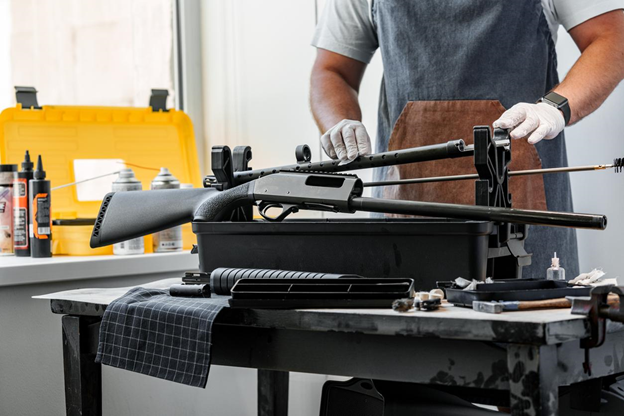
Pretty much all guns have moving parts, though the degree to which this is true depends on action style and the platform itself. Regardless, oiling moving parts after cleaning is part and parcel of cleaning a gun, which is why most gun cleaning kits come with gun oil.
Either way, it is true that you should only apply a drop or two of oil to moving parts, as oil will combine with fouling to create tar, which is very hard to remove if you let it accumulate. Just remember that less is more, and most moving surfaces need only a drop of oil, if that.
Field Stripping Is Not the Same as a Deep Clean
For most intents and purposes, when you get your gun home from the field or a trip to the range, you can remove the barrel, or just the bolt, giving you access to the barrel, and just clean the bore.
That’s fine most of the time, but at least once per season, you should give your gun a deep clean, which involves breaking it down completely, removing all pins and springs, and thoroughly cleaning all components before reassembling the gun.
The Mag Deserves Some Special Attention
For any mag-fed platform (which is basically any repeater or autoloader) you should remember that your rifle and pistol magazines are also sensitive components that should be cleaned periodically.
A clean pistol or rifle magazine will charge, feed, and drop smoothly, helping to prevent jams at the source. Whenever you deep clean your gun, round up your magazines and clean them as well.
Always Perform a Function Check After Reassembly
This last piece of advice actually has more to do with general functionality rather than it has to do with cleaning the gun, but if you don’t perform a function check after reassembly, you might not have noticed that you made a mistake or misplaced something until you were at the range and it was too late.
Here’s the deal: after you clean your gun, rack the action a few times to make sure everything is working as it should. That way you’ll know if any parts are missing before you visit the range or the field again.
Get a Gun Cleaning Kit with All You Need Here
Here for a gun cleaning kit or other essentials like brushes, patches, oilers or jags? Take a closer look through our collection and if you have any questions about what your gun cleaning kit should contain, get in touch with us. We would be more than happy to help.